

 March 1, 2025
 1 min read
Mechanical engineering has always been at the centre of innovation, from automobiles and aircraft to industrial machinery, robotics, electric vehicles, and advanced manufacturing systems. Today, however, the role of a mechanical engineer is moving beyond traditional design, production, and maintenance. Companies increasingly need engineers who can research new possibilities, develop better products, solve complex engineering problems, and contribute to the complete product development cycle.
Research and Development (R&D) brings together engineering fundamentals, product design, CAD, simulation, prototyping, testing, manufacturing, and continuous improvement. For mechanical engineering students, freshers, and professionals who enjoy understanding how things work and finding better solutions, R&D can be an exciting and technically rewarding career path.
From Idea to Product: How R&D Works
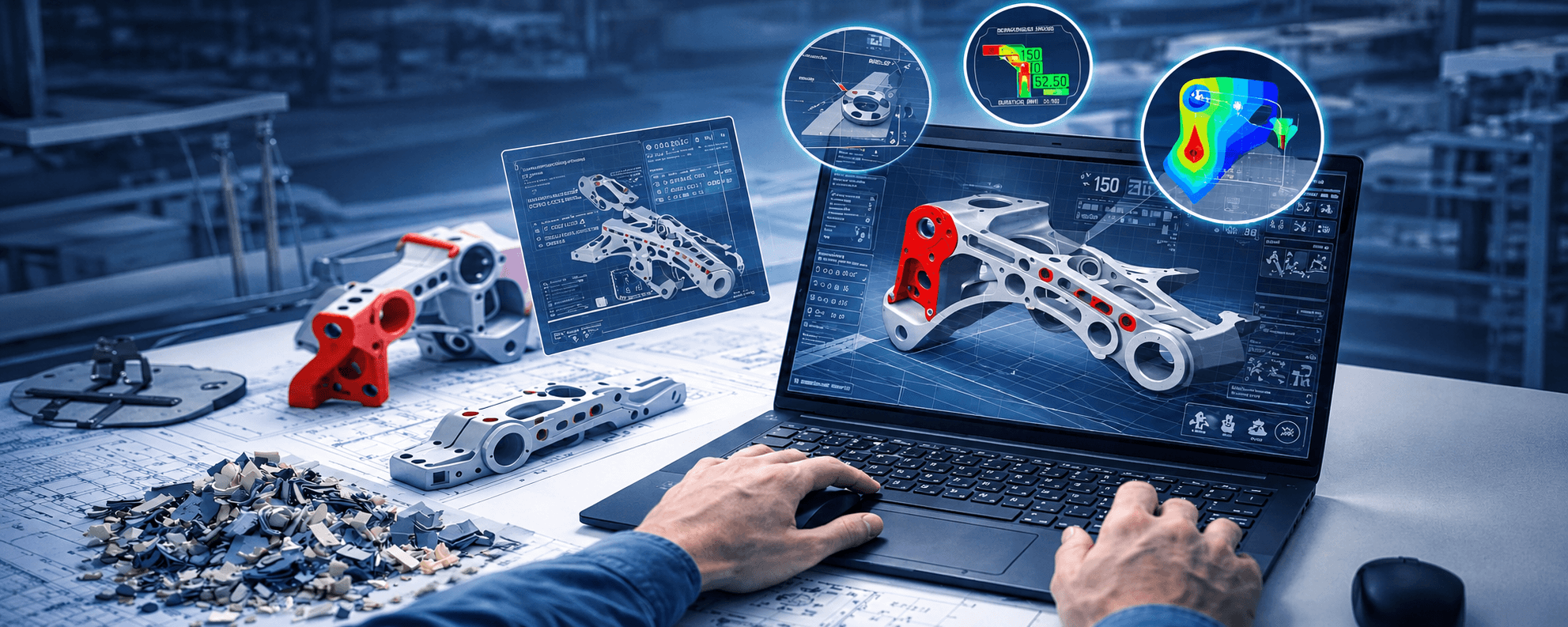
Every R&D project begins with a problem, requirement, or opportunity. An automotive company may want to make a component lighter without compromising its strength. An electric vehicle manufacturer may need a better battery enclosure or thermal management solution. A machinery manufacturer may want to increase component life while reducing manufacturing cost.
The first step is not always CAD modelling. Engineers need to understand the problem, study existing solutions, evaluate materials and technologies, analyse customer or product requirements, and determine whether the proposed concept is technically and commercially feasible.
Once the concept is selected, the development process moves through several stages:
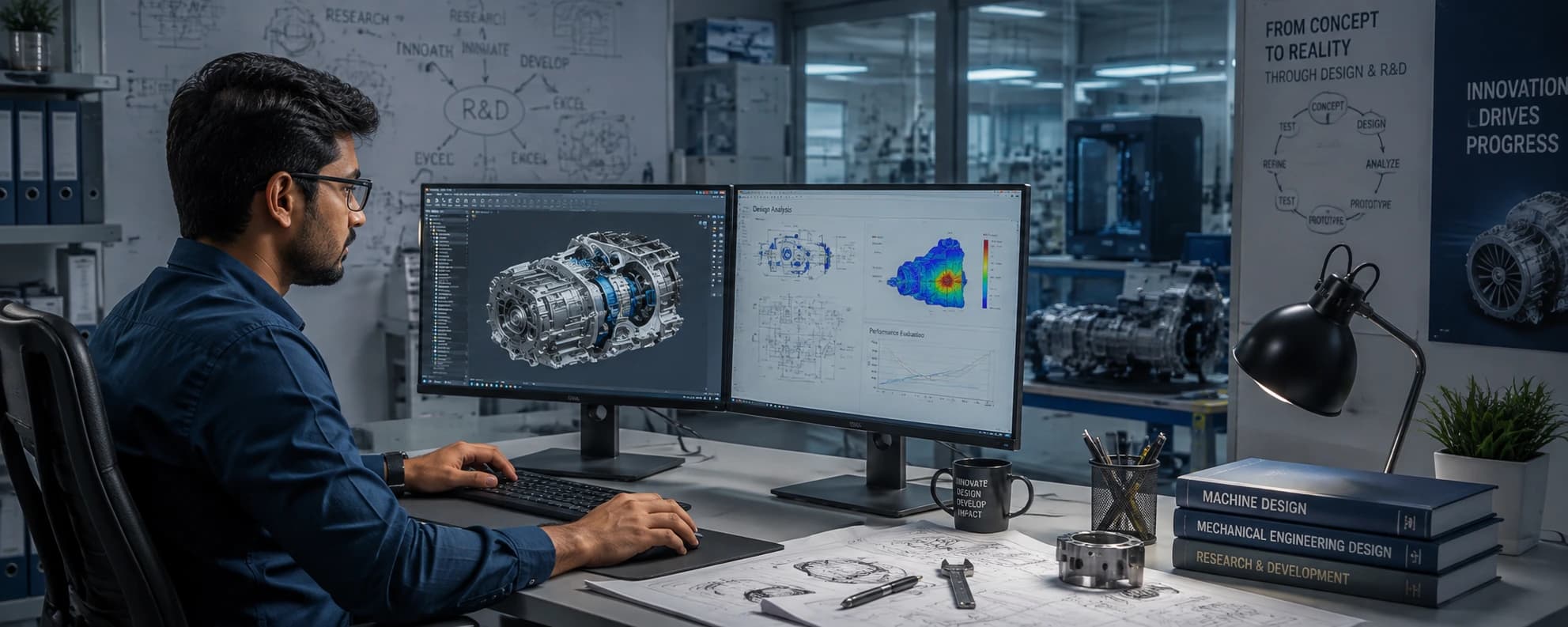
Requirement → Research → Concept → Design → Analysis → Prototype → Testing → Improvement → Validation
The process is rarely completely linear. A simulation may identify excessive stress, a prototype may fail during testing or the manufacturing team may discover that a particular design is difficult to produce. The R&D team then modifies the design and evaluates it again.This continuous cycle of Designing, Testing, Learning and Improving is what makes R&D different from routine engineering work.
For an R&D engineer, the objective is not simply to create a product. It is to create a solution that performs reliably, can be manufactured efficiently, meets quality requirements, and delivers the expected value.
CAD, CAE & Engineering Design: Beyond the 3D Model
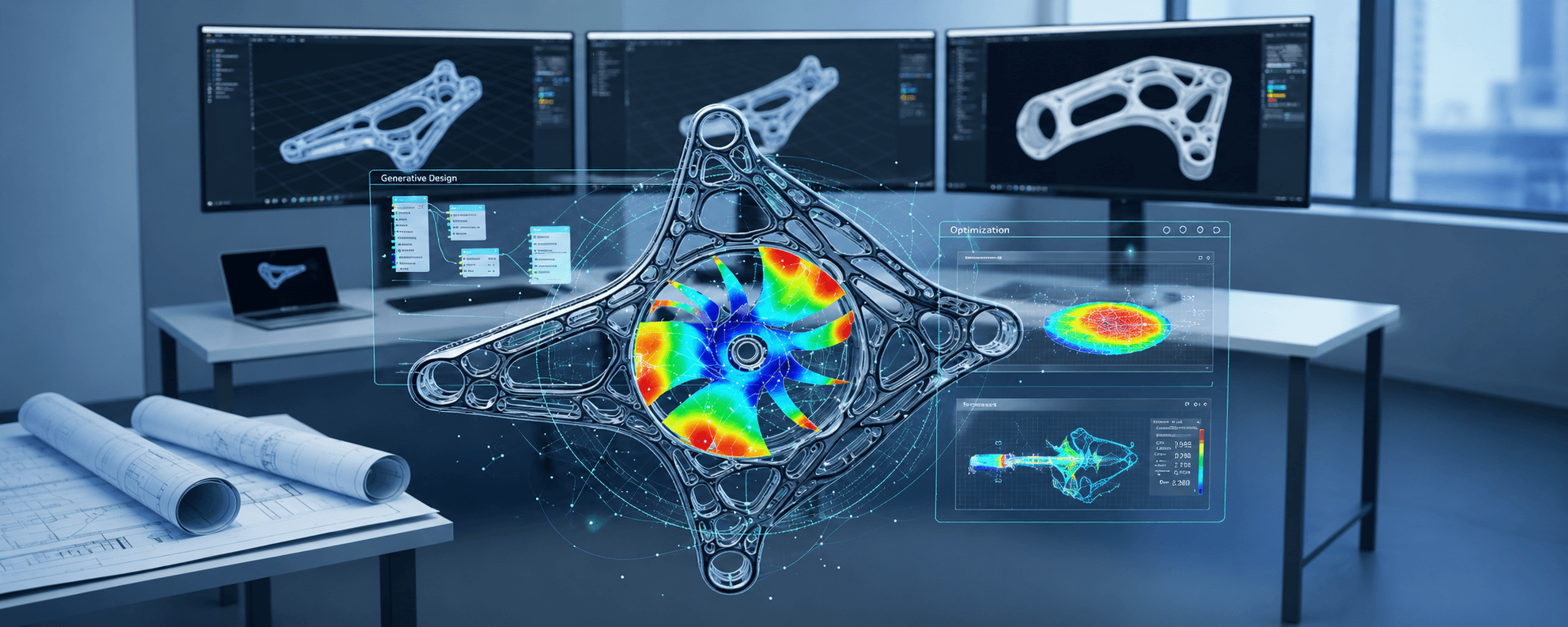
CAD is one of the most important tools used in mechanical R&D. Engineers may work with professional platforms such as CATIA V5, Siemens NX, Creo, SolidWorks and other industry-specific engineering software to develop components, assemblies, surfaces, drawings and product structures.However, knowing CAD commands does not automatically make someone an R&D engineer. A professional engineer must understand design intent, material behaviour, tolerances, manufacturing limitations, assembly requirements, service conditions, and product functionality.
Consider a simple mechanical bracket. Increasing its thickness may improve strength, but it can also increase weight and material cost. Reducing the thickness may save weight, but excessive stress or deformation could become a problem. An R&D engineer has to balance these factors before finalising the design.
This is where CAE and engineering simulation become important. Depending on the product, R&D engineers may work with:
- Structural analysis
- Thermal analysis
- Fatigue analysis
- Vibration analysis
- Motion simulation
- Computational Fluid Dynamics (CFD)
- Product performance analysis
Simulation can help engineers identify potential problems before manufacturing an expensive physical prototype. The design can then be modified and analysed again.
The combination of CAD + CAE + engineering fundamentals allows engineers to make better decisions during product development. Modern R&D is therefore not simply about knowing a CAD software package. The real skill is knowing how to use engineering tools to solve engineering problems.
Prototype, Testing & Manufacturing: Making Designs Work
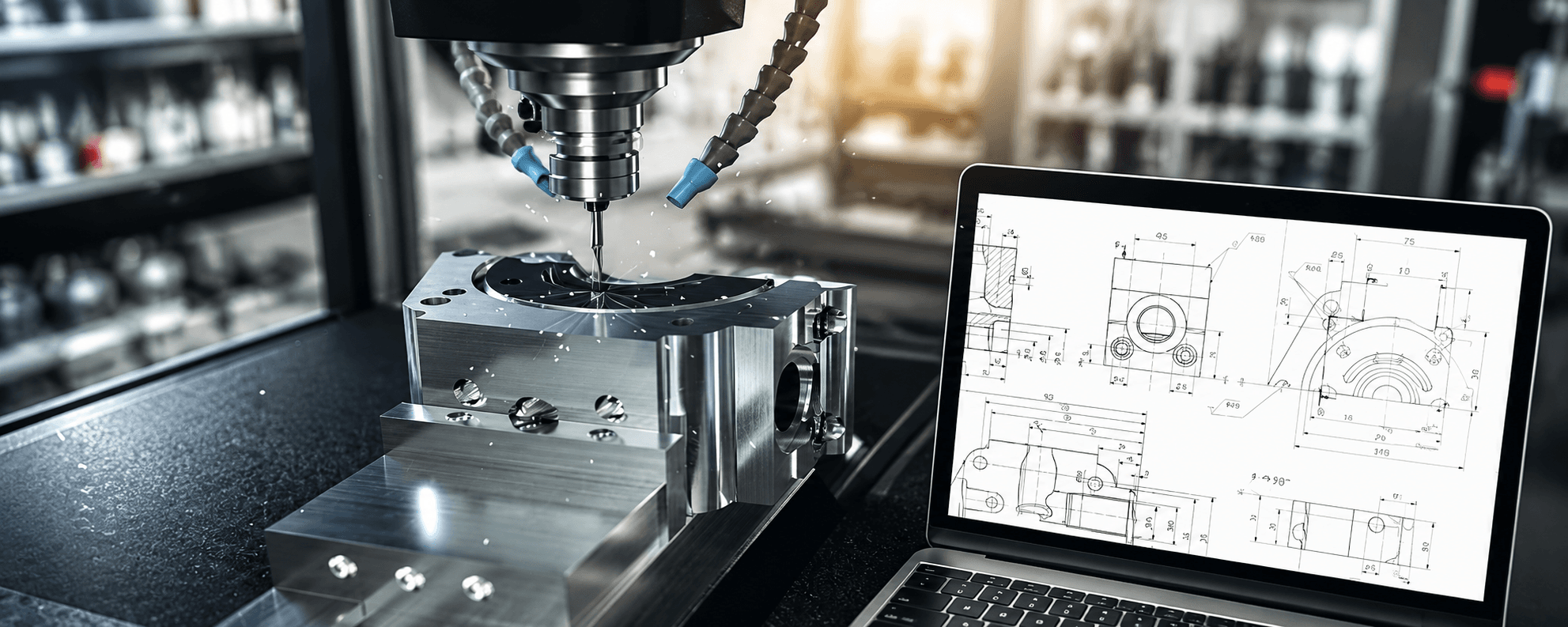
A successful engineering design must work in the physical world. A CAD model and simulation result may provide confidence, but physical prototyping and testing are often necessary to validate the final product.
A prototype can be used to evaluate fitment, assembly, functionality, strength, durability, vibration, thermal behaviour, ergonomics, and overall performance. Testing can reveal problems that were not visible during the initial design or simulation stage.
A failed prototype is not necessarily a failure of R&D. In many cases, it provides valuable engineering information. Engineers analyse the test results, identify the root cause, modify the design, and test it again. This process helps transform an initial concept into a reliable product.Manufacturing is equally important. A design that cannot be manufactured consistently and economically cannot become a successful production product. The manufacturing process influences geometry, material selection, tolerances, tooling, cost, and even the overall design approach.
Mechanical R&D engineers therefore benefit from understanding:
- CNC machining
- Casting and forging
- Sheet-metal forming
- Injection moulding
- Welding
- Additive manufacturing
- Tooling and production processes
- Design for Manufacturing (DFM)
- Design for Assembly (DFA)
A good R&D engineer does not ask only, “Can we design it?” The engineer must also ask, “Can we manufacture it reliably, efficiently, and at the required cost?”
This is where practical engineering knowledge becomes more important than simply knowing software.
Skills, Career Opportunities & Job Roles in R&D
A successful mechanical R&D engineer needs a combination of strong fundamentals, technical software skills, manufacturing knowledge, analytical ability, and problem-solving capability.The foundation comes from subjects such as Strength of Materials, Machine Design, Thermodynamics, Fluid Mechanics, Heat Transfer, Manufacturing Processes, Material Science and Engineering Drawing. On top of this foundation, engineers can develop professional skills in CAD, CAE, GD&T, prototyping, testing, product development and engineering documentation.
GD&T is particularly useful when working with product design and manufacturing teams because it helps communicate functional requirements accurately. Understanding datums, position, flatness, perpendicularity, parallelism, profile, and runout can help engineers create designs that are easier to manufacture, inspect, and assemble.R&D is also a highly collaborative function. Engineers work with design, CAE, manufacturing, quality, testing, suppliers, procurement, and project management teams. Therefore, technical communication and teamwork are important parts of the job.
Mechanical R&D opportunities are available across multiple industries, including:
- Automotive
- Electric Vehicles
- Aerospace
- Robotics and Automation
- Manufacturing
- Renewable Energy
- Industrial Machinery
- Consumer Products
- Medical Equipment
- Advanced Manufacturing
Depending on the organization, professionals can work as:
- Mechanical R&D Engineer
- R&D Design Engineer
- Product Development Engineer
- Mechanical Design Engineer
- Design & Development Engineer
- Automotive R&D Engineer
- Product Design Engineer
- CAE Engineer
- Testing & Validation Engineer
- Development Engineer
With experience, engineers can progress into Senior R&D Engineer, Lead Engineer, Technical Lead, Project Engineer, R&D Manager or Engineering Manager positions. They can also specialize in automotive product design, EV systems, CAE, thermal engineering, testing, materials, robotics, or advanced manufacturing.
The Future of R&D: Opportunities for the Next Generation

The future of mechanical R&D is being shaped by technologies such as electric vehicles, additive manufacturing, robotics, automation, advanced materials, digital twins, simulation, data-driven engineering and artificial intelligence.Electric vehicles are creating new opportunities in battery enclosures, thermal management, electric motors, lightweight structures and vehicle integration. Additive manufacturing is enabling engineers to explore complex geometries and faster prototyping methods. Robotics and automation are transforming manufacturing environments, while advanced materials are helping engineers develop products that are lighter, stronger, and more efficient.
This demonstrates engineering thinking rather than software familiarity.
Digital engineering is also changing the product-development process. CAD, CAE, simulation, digital twins and data-driven approaches allow engineering teams to evaluate concepts and identify potential problems earlier in the development cycle. Artificial intelligence is beginning to support areas such as design optimization, predictive analysis, engineering automation, and data interpretation.For fresh mechanical engineering graduates, this creates an important opportunity. R&D careers are not limited to experienced engineers. Freshers can enter the product-development ecosystem through internships, graduate engineering positions, CAD roles, mechanical design positions, testing roles, CAE opportunities and trainee positions.
However, simply listing software such as CATIA, NX, Creo or SolidWorks on a resume is not enough. Employers want to see how a candidate applies those tools to real engineering problems.
A strong project can demonstrate this clearly. Instead of creating a random CAD model, a student can select a real component, understand its function, study its manufacturing process, identify an improvement opportunity, develop a new design, perform relevant calculations or simulation, and explain why the final design is better.
This demonstrates engineering thinking rather than software familiarity.
For mechanical engineers who enjoy asking questions, solving technical problems, improving existing products and learning new technologies, R&D can offer a strong long-term career path.
The most valuable mindset is simple: Don’t just learn how to design a product. Learn how to make the product better.
Share this article

Related Articles
Explore more
DESIGN & ENGINEERING
How to Turn Your Mechanical Skills into a Career in Design and R&D
DESIGN & ENGINEERING